IPP Everywhere and AirPrint are virtually identical AFAIK, it's just that AirPrint uses a slightly different proprietary raster format because Apple is gonna Apple.
This echoes the tug-of-war customers are having over controller (and Steam Deck) size haha. People with big hands think the Steam Deck and PS5 controller are perfect and the Switch and PS4 controller suck. People with small hands feel the exact opposite.
The option is either clever engineering or choice. Apple chose the engineering route with their nanotexture screen coatings. Microsoft has done it with the XSX controller, which has clever cut-outs so people with small hands (kids) can hold it in a different but still-comfortable way. Hopefully TV OEMS figure out a way to ape Apple.
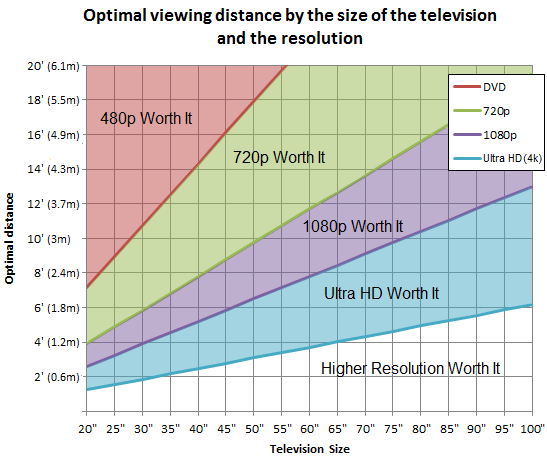
If you own a 50" 2160p ("4K") TV and are sitting more than 1.8m / 6ft away, you're already at the edge of being able to perceive any resolution increase over 1080p. For a 65" TV, its about 2.5m / 8ft.
So no, at typical viewing distance you are very unlikely to notice a sharpness decrease.
Tangentially related, but this is also why the 4K chase on this console generation is so stupid. The vast, vast majority of people will be viewing their TV way beyond the recommended viewing distance, and thus will only be resolving to 1080p with their eyes. We should be chasing better-looking effects and 120 FPS.
I’m at 65” and less than 2m away, and I absolutely can tell when text is not rendered at native resolution, which is why I’m also confident I’d be able to notice the matte coating too.
(I am also probably like three standard deviations _more annoyed_ by the blurriness than an average person, I’m more than willing to believe that an average person wouldn’t be able to tell, or at least wouldn’t be bothered by it anywhere close to the degree that I am.)
Well yeah, at that distance you are supposed to notice the difference in resolution, and presumably the difference between matte and glossy. Most living room situations aren't like that though.
Yes, unless you wanna go down the line of "well actually Apple screens are not that good".
This is a semi-sponsored video from a scammy company that makes glossy displays, so you might want to take it with a grain of salt, but it talks about a real effect with (most, again, Apple's etching is _much_ better, but still _noticeable to me_) matte coatings:
https://youtu.be/3mTV1TOblbA?t=124
There are people taking super-zoomed-in photos of their monitors all over reddit too, so you can judge how much haze/blurriness they add to the image:
In addition there's a lot more benefits your missing. 4K will be streamed at a higher overall bitrate with smaller artifacts and noise.
In addition HDR and 10 bit / 4:2:2 or 4:4:4 color can be huge differences in image quality on the right TV and source.
For the first example you could theoretically take a 4K signal and downscale to 1080P before display and theoretically get a lot of the benefits (assuming the person is far from their TV as you say). That being said a lot of people do sit closer and have larger TVs. And many people also have better vision than average.
Jumping from 4K to 8K I would say the differences are much less important given the massive file size increase. Many nicer cameras even only shoot in around "6K". Shooting higher resolution does allow you to do a bit of cropping and recomposing in post however which is nice. And of course things like stabilisation.
4K on phones though I think is truly dumb. Just wasting heat and battery life
You're confusing "benefits of playing 4K-mastered media" and "benefits of having more pixels on the panel"; which is what the original point was about.
Not sure what you mean, Brave blows Firefox out of the water in terms of privacy protections. Firefox has milquetoast fingerprint protection and it doesn't even block ads. uBlock is worse than Brave's blocking by virtue of not being natively integrated.
We're still talking about "zero-shot prompt" when the saying "X-shotted" ["One-shotted the difficult maze"] was already a well-established thing in daily vernacular. So now you constantly have to readjust your brain because whenever you read "zero-shot prompt" your mind goes "uh.. a zero-try attempt is a paradox and cannot exist".
Zero-shot, one-shot, few-shot etc. refers to how many examples you have to give.
It comes about from machine learning algorithms that could pick up on patterns from a small number of examples. Few shot means only a handful of examples to recognize something. One shot means only a single example. And zero shot means no examples. Of course, you have to indicate what you want somehow, but in the case of an LLM that's the prompt. Once LLMs were trained for instruction following, you didn't have to give any examples, you could just give a prompt describing what you want, and that was a zero-shot.
You're explaining something to me I already know. Hence the "readjust my brain".
I'm complaining about the LLM field co-opting a term that was already used in daily vernacular. Imagine if people in the LLM field made it so that saying the LLM made a "final answer" means that it got stuck in a loop. Now, whenever someone says an LLM gave a "final answer" we have to divine if they meant it is in a loop or gave the right answer after working through a few intermittent ones by itself.
Choosing to call it "X-shot" was a dumb move. And now we're stuck with it. No two ways about it.
What is really interesting about Linux users is that they cost an enormous amount in support.
I think it was a dev of the reboot of Planetary Annihilation that said their Linux users / build made up a few percent of the sales but over 90 percent of all support tickets (!). Mind you that this was before Valve's Proton.
If those bugs are only present in the Linux port, then yeah, Linux users cost more to support. But if a significant amount of these bugs affect all platforms, then you could argue that a Linux user is much more valuable to them than a non-Linux user because they provide better feedback. Assuming they actually care about fixing their product.
yes, this. i don't know if it was the same game another another where the devs said that while linux users send the most bug reports they are also the most grateful about having a game that runs on linux, and all their reports genuinely helped make the game better for everyone. (wildly paraphrased from faint memory)
in other words, if you want your game tested and get good feedback for it, do release on linux. maybe even release on linux first. linux users will love you for it, and you get to release a more polished game for a wider audience on windows.
Personally, I think it's probably best to test with Proton as part of a game development cycle to reduce the overall complexity in terms of development (not that games aren't already exceedingly complex). That's just my take... especially if you want to take advantage of that extra 5% or so potential extra market share.
Part of the problem is that Linux isn't really one platform, it's 10 different ones of varying popularity (e.g. supporting Gnome on Debian with Wayland doesn't mean that KDE on Nix with X will work). And it costs somewhere in that 1-10x range to support it because of that.
Steam fixed this years ago. Many native games will default to the Steam Linux Runtime to ensure long-term compatibility and generally consolidated runtime expectations: https://github.com/ValveSoftware/steam-runtime
Compared to the dylib nightmare that Microsoft keeps shipping in Windows, native Steam/Linux is actually pretty consolidated.
When I worked at a Linux distro I worked with one device maker who told me in confidence that 90% of their revenue came from Linux-based shops and they only needed a one-person support team. They had a 20 person support team for the remaining 10% of revenue coming from Windows-based shops.
Where I work now the top 10 customers are Linux shops. They probably account for 80% of our revenue. The remaining hundreds of customers are more evenly split between Linux and Windows.
So I guess it depends very much on what industry you're in. For consumer games it might be Windows, but outside of financials and administrative realms and into the world of embedded it's a heckuva lot of Linux. Support costs tend to be lower, and you really only have to target Red Hat and Ubuntu.
Yes, and I think a free-version user might produce more support requests than a commercial user for two reasons:
1) commercial/professional users might feel more entitled to support, but typically have a better understanding of linux and more versed in fixing stuff themselves.
-- and more importantly --
2) They probably have a dedicated setup where they can run the AMD-blessed distro
You can certainly see the modern Apple influence: 4 different instrument panels, 7 different corner radii.
The control panel is the odd one out at the moment, but perhaps in the next version they'll "upgrade" it to a lop-sided rhomircle instead. Maybe even find a way to make the seatbelt foul the accelerator pedal when in use, in homage to the Magic Mouse.
I like tactile knobs and switches. I can see my self enjoying using them, similar to a fidget toy. Or an earbuds case that you can close with a satisfying SNAP.
Look at the infotainment, you have the handle bar thing that you can feel and thus rest your hand vertically. But instead of just a row of flip switches, in the middle you have the depressed button and a wheel. All of this helps using it without taking your eyes of the road.
I don't have a way with words, but there is also something about the instruments cluster. Looks cool I guess. Reminds me of 80s / 90s Mercedes maybe? Shows everything without being too much.
What does something looking ugly have to do with it having buttons?
The interior looks like the car version of those "Xbox 720", "Gameboy Omega" meme renders from the late 2000s. It's just plain ugly.
Compare that to some of the beautiful devices Braun and Sony created in the past. Buttons don't prevent something from looking beautifully crafted. But ugly design does.
Thinking of it, you know who could design a beautiful Ferrari interior? Teenage Engineering. Look up the OB4 radio in red.
You're not the only one. Users have been screaming for tactile buttons for about a decade or more now. Mercedes recently switched to tactile buttons and more expected to follow.
But regarding this car, did you check where it says "CONTROL PANEL" in your link? It is still a flat screen ...
Anyway, none of this looks revolutionary to me. Whether you think it is aesthetically pleasing or not (I do not).
> "CONTROL PANEL" in your link? It is still a flat screen ...
Yes, it has 9 or so physical buttons. Those are the ones I talked about in the post you are replaying to. As long as you can most needed tasks by buttons I'm fine also having a touchscreen.
Just judging my the images it seems the climate On/Off is touchscreen only. Even though you can control temperature by buttons. Could be that you can enable / disable it via other means. (Double click climate or whatever)
> none of this looks revolutionary to me.
Yeah same. But then again I have no idea what was revolutionary in car dashboards. Maybe GPS navigation?
Logius is the company that actually owns and manages the DigiD stack, it's just that they hired Solvinity for their expertise. AFAIK Solvinity can't access the data.
I can't find it right now, but on Tweakers there was a long comment by someone on the inside that explained Logius basically had almost no know-how of how the current stack works, and there's lots of bespoke stuff. Basically classic vendor lock-in. The government (rather, Logius) now really wants to transition away from Solvinity, but that will likely be a 5+ year process.
I also feel like this is another thing that the "fast ring" of the EU should do together. Take Estonia's stack as a base, and then countries like Sweden, Denmark, Finland, The Netherlands adopt it and co- develop it. Make it extensible for the bespoke things the countries need, and every few years check which bespoke extensions can actually be generalized and modularized. Would lead to a much better product. A man can dream :)
> I also feel like this is another thing that the "fast ring" of the EU should do together. Take Estonia's stack as a base, and then countries like Sweden, Denmark, Finland, The Netherlands adopt it and co- develop it. Make it extensible for the bespoke things the countries need, and every few years check which bespoke extensions can actually be generalized and modularized.
Argentina's ministry of education did something like this with university software. The one used by students to sign up and by teachers to track grades, etc. There's a single open source modularised, customisable system made country-wide, and public universities customise it to their needs.
Before this initiative, every university was implementing their own software from scratch. In many cases, different faculties (e.g.: Engineering, Natural Sciences, Humanities, etc) each had their own software development teams developing their own independent software stack.
> Argentina's ministry of education did something like this with university software. The one used by students to sign up and by teachers to track grades, etc.
For what it's worth, this seems roughly equivalent to Moodle, which is open-source (GPL) and used globally, apparently especially popular in some of western Europe, the US, etc. [1] School systems can and do of course customise it as needed.
The problem with Moodle is that it's terrible. Yes you can customise it, but the core must be 20+ years old now, and it really shows. Universities don't have the talent in house to do anything more than bodge solutions for local bureaucratic knots. That doesn't generalise into an improving system over time.
It's even more complicated: the datacenter and the servers are owned and operated by the government, and the DigiD app itself is owned and operated by government-owned Logius.
From what I have been able to deduce, Solvinity is contracted for some kind of sysadmin services - so basically Kubernetes babysitting?
Honestly they have good separation of concerns in the Dutch government. And running the stack doesn't automatically mean hosting the services, there's enough local expertise in the Netherlands to run that.
A few years ago I had the mispleasure of working for the island government of Bonaire, and they kinda run the same systems as they do in the mainland, being a sort of municipality.
Since all gemeentes in the Netherlands are basically independently run but have to communicate with each other for DigiD but also the GBA (ID system) and loads of other stuff, they invented a standard. It's a SOAP based monstrosity called StUF, and you better spell it like that.
I can't find much about StUF in English, but there is this about the succesor where they lament on how engrained StUF still is.
It wouldn't surprise me that migration to common ground is what they are refering too. StUF knowledge is not widespread due to the level of vendor lock in. There's not many vendors and outside GovIT nobody cares about StUF.
Estonia's tech was cool maybe 20 years ago. From what I understand it's a bit too hard on fetishization of PKI and Ukraine goes too hard on apps. Netherlands actually gets it really well with DigId that is doing bare minimum needed to actually perform eidas stuff without getting into the woods with legally blessed asn1 schemas and oid [0].
I'm not sure what bespoke stuff they invented to get their sweet vendor lock in eurobucks, but the whole thing is nothing more than an OAuth provider for 19 million people. I guess NFC integration in the app that reads physical ids is on a fancier side, but I suspect on that side it's vendor locked by card vendor and their SDK.
Disclaimer: I have more exposure to Ukrainian variation of this setup (see jkurwa) than to actual Estonian and extrapolate a bit from what I heard from people. Half of this may be outdated or wrong, but I believe that the general vibe is correct.
From what I know about Estonian eID stack, they use traditional PKI to the full extent -- LDAP, PKI, OCSP, all the standard designs from the 90ies and then internally (for use by the government itself) they have a sort of a document exchange system on top of that where everything is done through CMS (PKCS). I believe this is why eIDAS and trust services directive talk about trust lists, qualified certificate authorities and all that.
So you get a physical id card that is a smart card for X509 certificate and then sign, encrypt and do all the stuff you do with keys once you figured out key management. Since the key can't leave the card you need to deal either with a special Estonian keyboard that doubles as a keyreader (in Ukrainian flavor we get a mobile app that can generate a key and get x509 issued remotely, maybe Estonia has that too nowdays or we get a file-based key from a trusted provider, like a bank) or get an actual keyreader or a phone. On the provider side you also have to deal with trust lists, because Estonia and Lithuania don't use the same root of course.
The first gotcha is -- if you have LDAP, CSP and OCSP and can query those, that's a bit of a privacy risk (AFAIK, primary key is based on the date of birth, because reasons). Second gotcha -- key rotation is not practical, so certificates are long lived. Certificates that I saw had demographic identifier of the person as a serial, which is not great for privacy, but convenient for deployment I guess (for comparison, Ukrainian flavor only allows CSP through subject key and has the number deep in the directory lookup extension)
I don't think the stack is bad, but I think it's an overkill for the basic feature of logging into the government website and blessing some bytes with your legal persona. It does help when the user signs a legal document and then tries to walk it back (for example because the document is now an exhibit A in a VAT fraud case, yes real story). I think this particular problem can be solved by non-technical means. More specifically, PKI solves the problem of verifying the identity of the user and then allowing to prove to a third party that it happened.
What is actually needed from the ID stack is allowing a first party in a closed system to match the token presented by a second party to their legal identity. I don't believe cryptographic signing or key derivation is really necessary, as the system that produces the key and the system that verifies the signed artifact are the same entity in most threat models.
I think DigID does the right thing by being a glorified OTP generator with more or less nice UX that solves just that. The actual problem is key provisioning anyways, but once you have done that, it isn't necessary to go full PKI.
To make my point even more ahm pointy, we don't use client X509 to log into github or google. We use passwords, HOTP and fidokeys, because x509 has bad UX and bad security too (in practice)
Add: downvotes for explaining why PKI is an overkill? okay, I will not survive that
I appreciate your comment, but don't bother complaining about moderation. It isn't an interesting read.
Why not use the cert on the ID to sign your own private key in the chain? That way, you can revoke the keypair should the need arise. The private key on the ID card would be valid for as long as the ID card is valid (here in NL: 18+, 10 years; 18- 5 years). And you can use each keypair for whatever. The benefit (and possible disadvantage) is the government knows you are you.
It's a wall of text prefaced by your disclaiming that you don't really know what you're talking about. So then why would I want to read that? Just say "yeah I'm not really sure about the details what I wrote above was word of mouth" and move on.
Maybe better, but less useful. I don't carry my Identity Card at all, unless I cross the border within EU where it is used. All other functions I have in our country app. To which I can log in using physical card, but I have other options that are online.
Not true. You have to be able identify yourself on the street in case the police wants to talk to you. A driver’s license is also valid identification.
What are the penalties for not doing so? I'm always amazed at the willingness of Europeans to follow rules like these, regardless of their impact on personal sovereignty. People in Finland were the most extreme example of this behavior that I've ever encountered. People would look like you murdered a child for jaywalking in Helsinki.
It's a nothing burger really. I have a card wallet for bank passes, transport cards and the id thingy. Not a single cop ever stopped me (I'm not in the usual suspect demographics, so that helps), so I didn't have to show it ever in 7 years. I imagine I would have a different attitude if cops did actually ask for it for no reason.
I however heard about things like riding a bicycle without lights and being fined 50 bucks for that, which triggers asking for an id, which in it's turn triggers a 100 euro fine on top. In the story I heard the second fine wasn't actually given.
Why carrying it is practical? What is it used for?
The only time I need my ID is during elections, but I can also show the one I have in our government produced app.
Older people in Poland do carry those, mostly out of some kind of habit and some kind of fear that police might need it. I can drive a car and get a speeding ticket, and all I need police to know is my ID number (it is not the identifier of my identity card), which I know by hard, it consists of my birth date plus 5 semi-random numbers). I don't need my ID, my driving license nor my insurance data - everything is located in police database based on my ID number (or my license plate).
Bad sides of carrying it is that you might loose it, and that is a PITA, because you need to block it right away (someone might take a loan with it, happens I kid you not) by calling your bank or similar service.
So I take it out from my wallet (which I don't carry also) only when I go to the airport.
Not exactly. The Netherlands has an identificatieplicht (an obligation to identify yourself), not a formal draagplicht (an obligation to physically carry ID at all times).
Police may require identification only in specific situations connected to their duties, not arbitrarily. If you cannot show valid ID when requested, you can still be fined or taken to a police station to establish your identity, so in practice most people do carry ID anyway.
The distinction is historically sensitive in the Netherlands because compulsory identification documents were heavily associated with Nazi occupation policies during World War II.
It's a state owned enterprise as far as I remember. So technically they don't wear civil service uniforms in the office, but still get the usual government office hours.
I once interviewed for a job at what I think was a civil service branch that developed software for the military. But they were out of budget for this, while the military did have budget, so if I was hired, I'd have to wear a military uniform to the office. A very stylish one, they claimed.


reply